When is the winter solstice in 2025? The winter solstice occurs on Sunday, December 21, 2025, at 10:03 AM Eastern Time (15:03 UTC). This is the shortest day of the year in the Northern Hemisphere, with the fewest hours of daylight and the longest night. After the solstice, days gradually lengthen until the summer solstice in June.
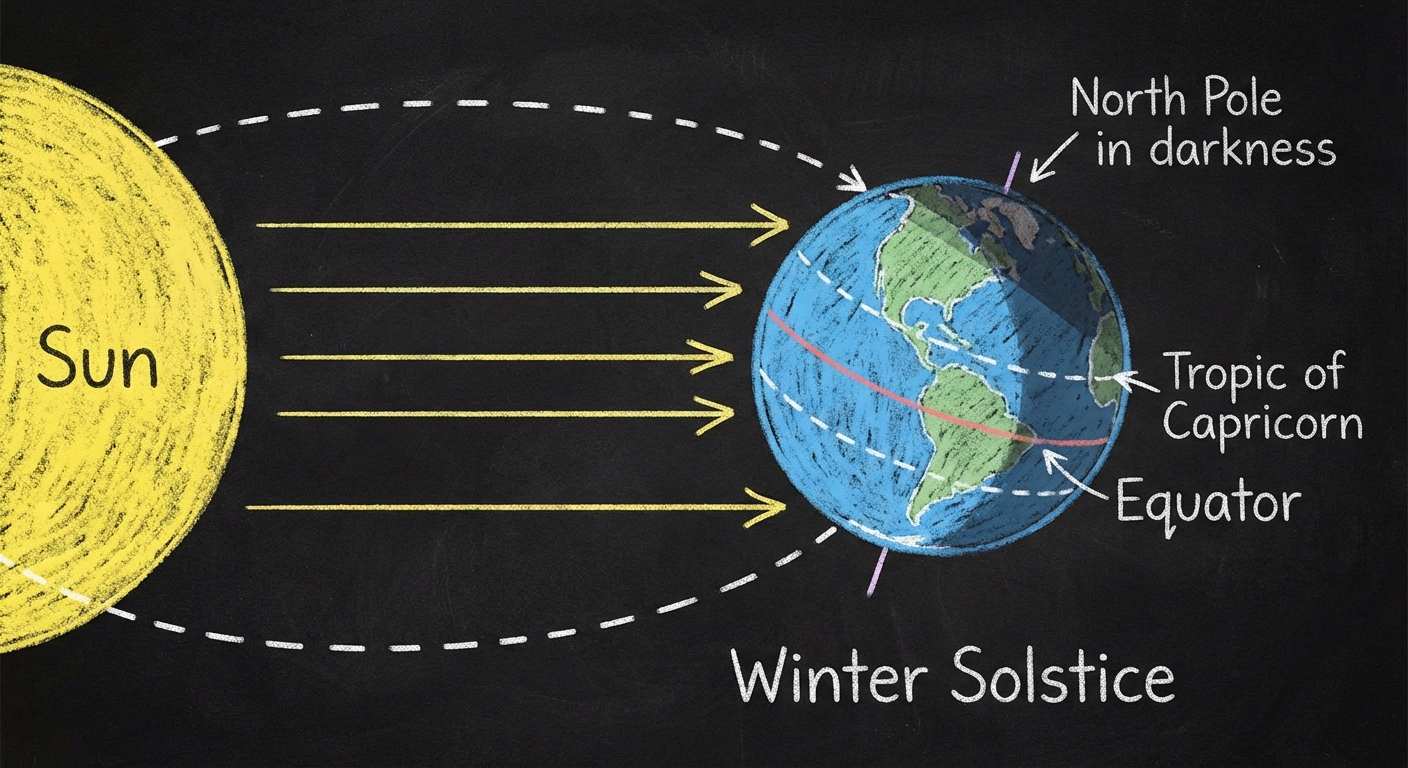
The solstice marks an astronomical event, not just a date on the calendar. It’s the precise moment when the North Pole is tilted farthest from the Sun during Earth’s orbit, causing the Sun to appear at its lowest point in the sky at noon.
What Causes the Winter Solstice
Earth’s axis tilts approximately 23.5 degrees relative to its orbital plane around the Sun. This tilt causes the seasons. During the Northern Hemisphere’s winter, the North Pole angles away from the Sun, meaning sunlight hits the northern half of Earth at a lower angle and for fewer hours each day.
At the winter solstice, this tilt reaches its maximum. The Sun’s arc across the sky is the lowest and shortest of the year. At 40 degrees north latitude (roughly New York, Madrid, or Beijing), the Sun rises in the southeast and sets in the southwest, barely climbing above the horizon compared to summer.
The exact moment of solstice isn’t midnight or noon but whenever the Sun reaches its southernmost position from Earth’s perspective. In 2025, that moment happens mid-morning for the Eastern United States and mid-afternoon for Europe.
How Much Daylight Will There Be?
The hours of daylight on the winter solstice vary by latitude. The farther north you live, the shorter your day.
In Miami (25°N), the solstice brings about 10 hours and 32 minutes of daylight. In New York (41°N), expect approximately 9 hours and 15 minutes. Seattle (47°N) sees roughly 8 hours and 25 minutes. Anchorage, Alaska (61°N) gets just 5 hours and 28 minutes of daylight. Above the Arctic Circle, the Sun doesn’t rise at all.
The difference in solar intensity matters too. Because the Sun stays low in the sky, its rays hit the ground at a shallow angle, spreading the same energy over a larger area. This is why December sunlight feels weaker than June sunlight, beyond just the reduced hours.
Why the Coldest Weather Comes Later
You might expect the shortest day to also be the coldest, but winter’s deepest chill typically arrives in January or February. This delay, called seasonal lag, happens because Earth’s surface, especially the oceans, stores heat from summer that takes time to dissipate.
Think of it like a pot of water on a stove. When you turn down the heat, the water doesn’t instantly become cold. It gradually releases stored thermal energy. Similarly, even as incoming solar energy decreases after the summer solstice, the Earth continues releasing stored heat. Only after weeks of losing more heat than it gains does the surface reach minimum temperatures.
So while December 21 marks the turning point when days start lengthening, the coldest weather is still ahead for most of the Northern Hemisphere.
Cultural Significance of the Solstice
Humans have marked the winter solstice for thousands of years. Prehistoric monuments like Stonehenge and Newgrange align with the solstice sunrise or sunset, suggesting the event held deep significance for ancient peoples. The solstice represented the “rebirth” of the Sun, the promise that light and warmth would return.
Many modern winter holidays have roots in solstice celebrations. Christmas, Hanukkah, and other December festivals occur near the solstice, incorporating themes of light conquering darkness. The Roman festival of Saturnalia, the Norse Yule, and countless other traditions centered on this astronomical turning point.
Today, some people celebrate the solstice directly with bonfires, lantern festivals, or simply taking a moment to appreciate the returning light. Whether or not you mark it formally, the solstice is a reminder of Earth’s journey around the Sun and the cyclical nature of seasons.
Summary
The winter solstice 2025 occurs on Sunday, December 21, at 10:03 AM Eastern Time. It marks the shortest day and longest night in the Northern Hemisphere, after which days begin lengthening toward summer. The event is caused by Earth’s axial tilt, which points the Northern Hemisphere farthest from the Sun at this point in our orbit.
Despite being the shortest day, the coldest weather typically comes later due to seasonal lag. The solstice has been celebrated across cultures for millennia as a symbol of light returning to the world.